


Lake Desilting: Methods, Benefits and How to Choose the Right Approach
Desilting, or dredging, is the mechanical or physical excavation of accumulated soil runoff, sand, decaying organic sludge, and debris from the bed of a water body. The objective is to restore the original depth and water-holding capacity of the lake.
As sediment accumulates, the capacity and functioning of a lake can be affected. Understanding when a lake requires desilting and selecting the appropriate method are therefore important parts of lake restoration and management.
Key Indicators That a Lake Needs Desilting
Several conditions can indicate that a lake requires desilting.
Significant Depth Loss
Silt accumulation reduces water retention volume and can make surrounding areas more vulnerable to urban flooding during rain events.
Anaerobic Sludge Buildup
Organic matter can settle at the bottom of a lake and decompose without oxygen. This process can produce hydrogen sulfide and methane gases, resulting in foul odors and fish kills.
Internal Nutrient Pollution
Sediment can become saturated with phosphorus and nitrogen. These nutrients may continuously leach back into the water column, contributing to persistent algal blooms and eutrophication even when surface pollution is controlled.
Proliferation of Invasive Weeds
As silt brings the lake bed closer to the surface, sunlight can reach the bottom across a wider area. This can accelerate the spread of water hyacinth and rooted aquatic weeds.
Blockage of Inlets and Outlets
Silt deposits can block natural feeder channels, storm drains, and spillways, disrupting the hydrological flow into and out of the lake basin.
What Is the Best Season for Desilting?
Desilting should be carried out during the peak dry season or pre-monsoon period, when water levels are at their lowest.
This period allows heavy machinery to access the lake bed directly, minimizes dewatering costs, and enables maximum silt removal before seasonal rains refill the basin.
Major Methods of Lake Desilting
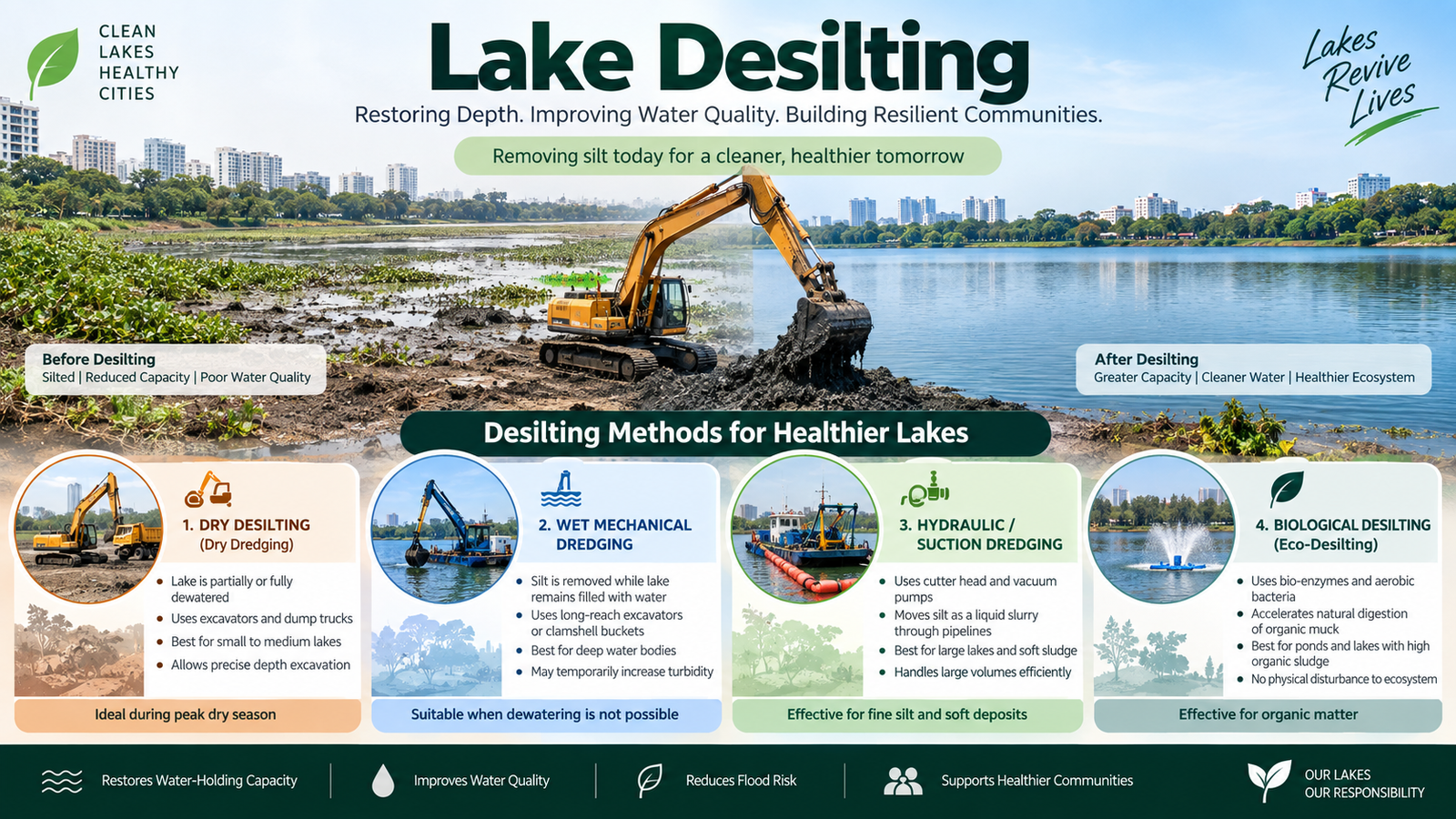
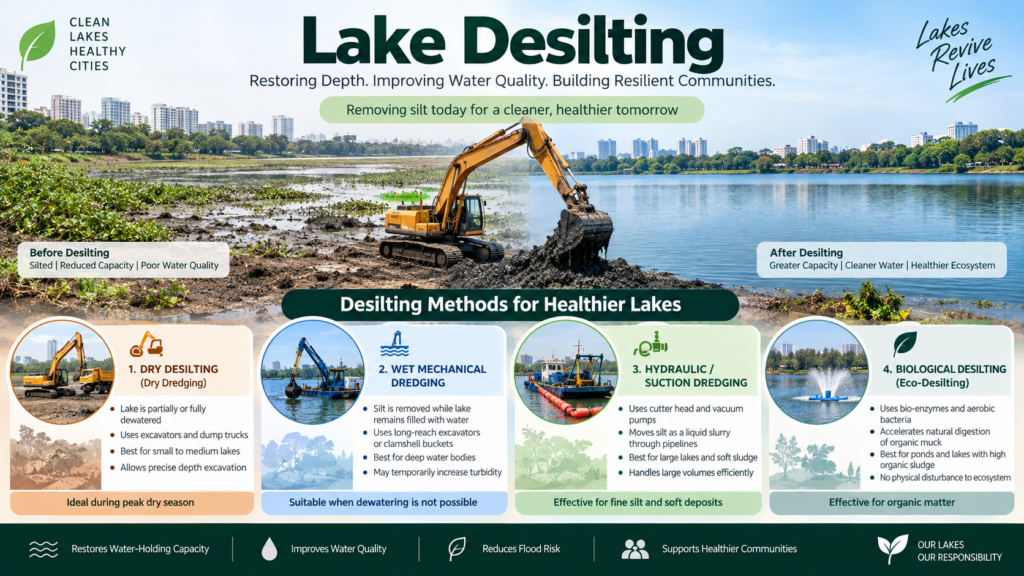
Desilting methods are primarily classified according to the water level during operation and the machinery used.
1. Dry Desilting
Also known as dry dredging, this method involves fully or partially dewatering the lake so that land-based heavy machinery can enter the exposed lake bed.
Excavators, bulldozers, and dump trucks can then be used to excavate hardened silt directly.
Best used for:
- Small-to-medium urban lakes
- Shallow ponds
- Seasonal water bodies during peak dry seasons
Advantage:
Dry desilting allows precise depth excavation and easier transportation of dry soil, although it temporarily displaces aquatic life.
2. Wet Mechanical Dredging
Wet mechanical dredging removes sediment while the lake remains filled with water.
Long-reach excavators, clamshell buckets, or draglines mounted on floating barges or shorelines can scoop sediment directly from underwater.
Best used for:
- Deep water bodies
- Lakes that cannot be drained because of active water supply requirements
- Targeted areas near inlets
This method eliminates the cost and impact of dewatering, but disturbing sediment can temporarily increase water turbidity.
3. Hydraulic or Suction Dredging
Hydraulic dredging uses a floating dredger with a rotating cutter head to loosen bottom sediment. The sediment is then vacuumed as a liquid slurry and pumped through pipelines into dewatering bags, such as geotextile tubes, or drying basins.
Best used for:
- Large lakes
- Reservoirs
- Soft organic sludge
- Fine silt deposits where transporting heavy wet soil by trucks is impractical
The method is highly efficient, can minimize underwater cloudiness, and can handle large volumes of soft sediment quickly.
4. Biological Desilting
Biological or eco-desilting is a non-mechanical approach using targeted bio-enzymes, specialized aerobic bacterial consortia, and continuous aeration through floating or subsurface aerators.
The objective is to accelerate the natural digestion of organic bottom muck.
Best used for:
- Ponds
- Urban lakes with heavy organic sludge from domestic sewage inflow
It causes no physical disturbance to the lake ecosystem, can eliminate anaerobic odors, and can reduce muck depth naturally over time. However, it is effective against organic matter and does not remove inorganic sand or clay.
How to Select the Right Desilting Method
Selecting a desilting method requires analysis of both water column parameters and sediment or sludge parameters.
The decision depends on physical sediment properties, chemical contamination levels, and ecological vulnerability.
Organic Matter and Volatile Solids
Sediment with high organic content can indicate soft, decomposing muck, while low organic content indicates predominantly inorganic material such as sand, gravel, or clay.
The document identifies:
- High organic content: >50–60% — soft, decomposing muck
- Low organic content: <20% — mostly inorganic sand, gravel, or clay
For high-organic sediment, biological desilting or hydraulic dredging can be considered. For low-organic sediment, dry desilting or wet mechanical dredging can be considered.
Particle Size and Texture
Particle size also influences method selection.
- Coarse particles >0.5 mm: sand and gravel; these can jam hydraulic pumps.
- Fine particles <0.063 mm: silt and clay; these are easily suspended in liquid.
Coarse sediment can be handled through dry desilting with excavators or bucket dredging, while fine silt can be suited to hydraulic suction dredging.
Bulk Density and Moisture Content
Sediment density and moisture content also influence the appropriate approach.
- Low density / high moisture <1.2 g/cm³: fluidized slurry
- High density / low moisture >1.5 g/cm³: compacted bed sediment
Low-density slurry can be suited to hydraulic suction dredging, while compacted sediment can be addressed through cutter-head dredgers or dry mechanical excavation.
Chemical and Contaminant Considerations
Before disturbing lake sediment, its chemical and contaminant profile must also be considered.
Heavy Metals and Toxins
The document identifies contaminants including:
- Lead (Pb)
- Cadmium (Cd)
- Chromium (Cr)
- Arsenic (As)
- Microplastics
High toxicity or heavy contamination creates a risk of secondary pollution when sediment is disturbed.
For highly contaminated sediment, hydraulic dredging into closed geotextile dewatering bags or complete dry desilting can be used to prevent resuspension into the water column. Standard wet mechanical dredging should be avoided where it would cause severe resuspension.
Phosphorus and Nitrogen
Sediment containing high levels of total phosphorus and nitrogen can act as a continuous internal nutrient source and contribute to algal blooms.
Physical removal through dry or hydraulic desilting can address this internal nutrient load. Biological digestion can convert organic matter but leaves inorganic phosphorus in the basin.
ORP and Hydrogen Sulfide
A strongly negative oxidation-reduction potential, or ORP, indicates deeply anaerobic and septic sludge.
The document identifies -100 to -300 mV as strongly negative ORP associated with anaerobic sludge producing toxic gases.
Biological aeration or bioremediation can be used as pre-treatment to oxidize anaerobic gases before dry desilting.
Water Column Vulnerability
The condition of the water column is another important consideration.
Dissolved Oxygen and Sediment Oxygen Demand
Low baseline dissolved oxygen combined with high sediment oxygen demand means disturbing sediment can consume the remaining oxygen rapidly.
The document identifies:
DO <3 mg/L with high SOD
as a condition where dry desilting after temporary fish rescue and dewatering, or hydraulic dredging with turbidity curtains, can be considered.
Wet mechanical dredging should be avoided in such conditions because it can trigger acute fish kills.
Total Suspended Solids and Turbidity
Where aquatic flora and fauna are highly sensitive to turbidity, sediment plumes can create additional ecological concerns.
Hydraulic dredging with contained suction or dry desilting can be considered in such conditions.
Quick Decision Framework for Lake Desilting
The document provides four broad situations for selecting a desilting method:
Biological Desilting
Consider biological desilting when:
- Sediment volatile solids are above 60%
- Water depth makes mechanical access difficult
- The primary issue is organic sewage sludge rather than inorganic silt or sand
Dry Mechanical Desilting
Consider dry mechanical desilting when:
- The lake bed is accessible during the dry season
- Sediment is dense or compacted
- Heavy sand or debris is present
- Complete removal of internal phosphorus loads is required
Hydraulic Suction Dredging
Consider hydraulic suction dredging when:
- The lake cannot be dewatered
- Sediment consists of fine slurry with density below 1.2 g/cm³
- Heavy metals or toxic contaminants require closed-pipe transportation to dewatering units
Wet Mechanical Dredging
Consider wet mechanical dredging when:
- Water levels must remain high
- Sediment contains large debris or rocks
- Turbidity and resuspension impacts on downstream ecosystems are low.
Desilting When BOD Is Below 50 mg/L
The document identifies BOD below 50 mg/L as indicating low-to-moderate organic pollution compared with raw sewage, which typically ranges from 150 to 400 mg/L.
Under this condition, the accumulated lake-bed material is primarily identified as inorganic sediment such as sand, clay, and silt runoff, rather than pure organic sludge.
Recommended Approach
Primary Method: Dry Mechanical Desilting
If the lake can be dewatered, dry mechanical desilting is the primary method.
Because the sediment is mainly inorganic soil and sand, biological digestion is not effective. Excavators and dump trucks are required to physically remove the compacted, mineralized bed layer during the dry season.
The recommended execution is to partially or completely dewater the basin, allow the bed to dry sufficiently to support machinery, and excavate to the original hard strata depth.
Alternate Method: Hydraulic Suction Dredging
If dewatering is not feasible and the lake must remain filled with water, a cutter-suction hydraulic dredger can vacuum fine silt slurry through pipelines into geotextile dewatering tubes.
Turbidity curtains can be used around the dredger to protect aquatic life from localized sediment disturbance.
Why Biological Desilting Is Ineffective at BOD <50 mg/L
Biological desilting using bio-enzymes and bacterial consortia depends on biodegradable organic carbon to digest muck into carbon dioxide and water.
At BOD below 50 mg/L, organic digestion will clear only a small fraction of the surface layer.
Microbes cannot digest sand, silt, clay, or heavy metals. Therefore, biological methods will not significantly restore lake depth where the sediment is predominantly inorganic.
Key Verification Before Desilting
Before finalizing excavation machinery, the document recommends conducting a Sediment Volatile Solids (VS) test on a core sample.
The decision thresholds provided are:
- VS <30%: Inorganic-dominant sediment — proceed with mechanical dry desilting or hydraulic dredging.
- VS >60%: Organic-dominant sediment — pair physical dredging with aeration to oxidize anaerobic gases before excavation.
Choosing Between a 15-Acre and 72-Acre Lake
Lake surface area alone should not determine desilting priority.
The document identifies the following factors as important:
- Silt volume percentage
- Flood risk
- Upstream silt control
- Available budget
15-Acre Lake
A 15-acre lake can have:
- Lower financial requirements
- More manageable haulage logistics
- Faster execution
- Easier complete dewatering for dry mechanical desilting
It may be suitable where the budget is limited or rapid restoration is required for a local catchment.
72-Acre Lake
A 72-acre lake can provide significantly greater total water-storage recovery and regional groundwater recharge.
However, it can require:
- Greater capital investment
- Multi-season planning
- Specialized machinery such as cutter-suction hydraulic dredgers
When to Prioritize the 15-Acre Lake
The 15-acre lake should be prioritized under the following conditions:
- Critical capacity loss: The lake has lost a higher percentage of its depth, such as 70–80% siltation, compared with the larger lake.
- Active inlet traps: Upstream sewage and silt inflows have already been diverted or intercepted.
- Budget limitations: Funding is sufficient for complete excavation and haulage of the 15-acre lake but would only support fragmented or partial desilting of the 72-acre lake.
- Immediate flood danger: The lake is directly upstream of high-density residential areas vulnerable to flash flooding.
When to Prioritize the 72-Acre Lake
The 72-acre lake should be prioritized under conditions such as:
- Regional hydrology impact: It functions as a primary flood-balancing reservoir or feeder body for a cascade of downstream urban lakes.
- Heavy machinery access: The site has access roads capable of handling heavy tipper traffic of 50+ trips per day, or sufficient space for geotextile dewatering yards.
- High water demand: Surrounding communities depend on groundwater recharge across a large geographic footprint.
Conclusion
Lake desilting is not a one-method process. The appropriate approach depends on the condition of the sediment, water quality, contamination profile, ecological vulnerability, lake accessibility, water levels, and the scale of the restoration requirement.
Dry mechanical desilting, wet mechanical dredging, hydraulic suction dredging, and biological desilting each have specific applications.
The document’s decision framework emphasizes that sediment testing and site-specific assessment should guide the selection of machinery and desilting method. In particular, parameters such as volatile solids, particle size, density, contamination, phosphorus and nitrogen levels, ORP, dissolved oxygen, and turbidity provide the basis for selecting an appropriate approach.
For lakes where sediment is predominantly inorganic, mechanical or hydraulic removal is identified as the appropriate approach, while biological methods are suited primarily to organic sludge conditions.
Ultimately, lake prioritization should consider siltation levels, flood risk, upstream controls, hydrological importance, accessibility, community water dependence, and available funding rather than lake size alone.