


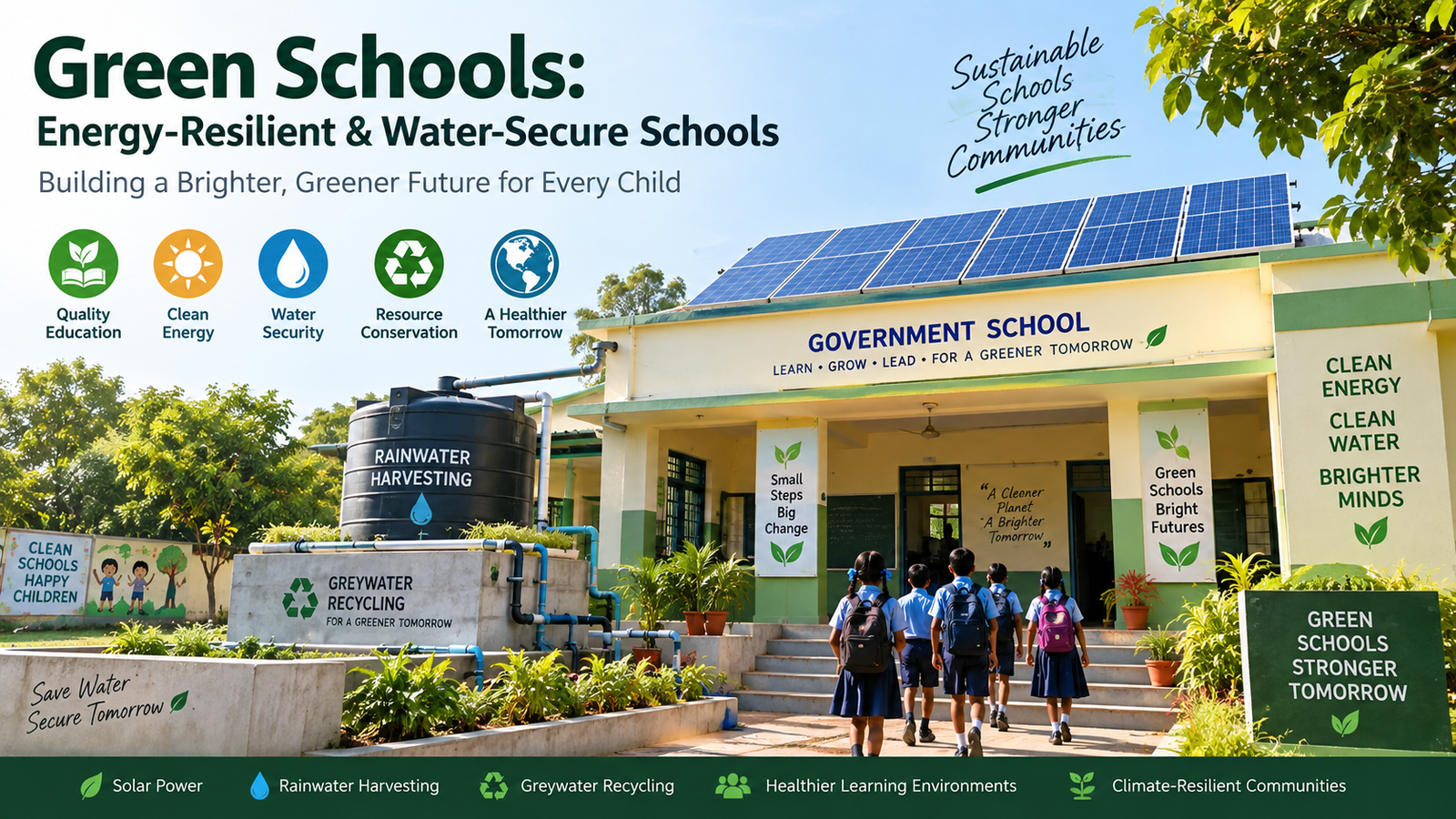

Green Schools: Energy-Resilient & Water-Secure Schools
Education is one of the most powerful investments a society can make. Every year, government schools receive valuable support through corporate CSR initiatives, including books, computers, digital learning equipment, sanitation facilities, drinking water systems, and other essential resources.
These contributions can make a meaningful difference. But there is a fundamental question that deserves greater attention:
Can these investments deliver their full potential when a school does not have reliable electricity and water?
A computer laboratory needs dependable electricity. A digital classroom needs power. A sanitation facility needs water. Hygiene programs need functioning taps. During hot summer months, students and teachers also depend on fans, lighting, and ventilation to maintain a comfortable learning environment.
This is why Green Schools are becoming an important model for sustainable school infrastructure.
By integrating rooftop solar power, greywater recycling, rainwater harvesting, and groundwater recharge, schools can become more energy-resilient, water-conscious, and environmentally responsible.
The Infrastructure Gap in Government Schools
CSR programs have traditionally focused on providing individual resources to schools. These interventions remain important, but the supporting infrastructure is equally critical.
When basic utilities are unreliable, the effectiveness of other investments can be reduced.
Technology Needs Reliable Electricity
Digital education has become an important part of modern learning. Computers, projectors, smart classrooms, digital laboratories, and other educational technologies all depend on electricity.
Frequent power interruptions can limit the use of these facilities and affect the continuity of digital learning.
A rooftop solar power system can provide a decentralized source of renewable electricity for essential school requirements such as:
- Classroom lighting
- Fans and ventilation
- Computer laboratories
- Digital learning equipment
- Essential electrical systems
By improving energy reliability, schools can make better use of existing and future investments in educational technology.
Water Security Is Essential for Healthy Schools
Water is fundamental to school health, sanitation, and hygiene.
Students and staff require reliable water access for:
- Handwashing
- Toilet use
- Cleaning
- Drinking
- Maintaining school greenery
- General hygiene
When water availability becomes inconsistent, even well-designed sanitation and hygiene facilities can become difficult to maintain.
A sustainable school therefore needs to look beyond simply installing water facilities. It must also consider how water is sourced, conserved, reused, stored, and replenished.
Greywater Recycling: Reusing Water Responsibly
Water used for handwashing and other suitable activities does not always have to become waste.
With an appropriately designed treatment system, greywater can be collected, treated, and reused for suitable non-potable applications.
A school-level greywater recycling system can potentially support:
- Toilet flushing
- Landscape irrigation
- Maintaining school greenery
- Other approved non-potable uses
This approach can reduce freshwater demand while introducing students to the concept of circular water management.
The treatment technology and reuse applications should always be designed according to the school’s site conditions, water quality, applicable standards, and technical requirements.
Rainwater Harvesting for Water-Resilient Schools
Rainwater harvesting is another important component of sustainable school infrastructure.
School rooftops can provide valuable catchment areas during the monsoon. Instead of allowing rainwater to become uncontrolled runoff, an appropriately designed system can collect, filter, store, or direct it towards groundwater recharge.
A typical rainwater harvesting system may follow a process such as:
Rooftop → Collection → Filtration → Storage / Recharge
Recharge pits and other suitable recharge structures can help return water to the ground where local soil, groundwater, and site conditions make this appropriate.
This can contribute to better water management and improve resilience during periods of water stress.
A Sustainable Green School Model
Dhruvansh Organization proposes an integrated approach built around three key interventions:
1. Rooftop Solar Power
A proposed 3 kW rooftop solar PV system can help provide renewable electricity for essential school requirements.
Solar power can support lighting, fans, computer laboratories, and digital learning infrastructure while reducing dependence on conventional grid electricity.
2. Greywater Recycling
Suitable wastewater from school wash areas can be collected and treated for appropriate non-potable reuse.
This can help reduce freshwater consumption and encourage responsible water management.
3. Rainwater Harvesting and Groundwater Recharge
Rainwater from school rooftops can be collected and directed towards storage or appropriately designed groundwater recharge systems.
Together, these interventions can create a more integrated and sustainable utility system for schools.
How Green Schools Can Support Better Learning
Sustainable infrastructure is not only about environmental benefits. It can also support the everyday functioning of a school.
Reliable electricity can help keep digital classrooms and computer laboratories operational.
Reliable water can support sanitation and hygiene.
Better ventilation and access to electricity can contribute to a more comfortable classroom environment.
Water conservation systems can reduce pressure on local water resources.
The result is an infrastructure ecosystem designed to support both education and sustainability.
Green Schools and the UN Sustainable Development Goals
The Green School model aligns with several United Nations Sustainable Development Goals (SDGs).
SDG 4 – Quality Education
Reliable electricity and functional infrastructure can support digital learning and improve the learning environment.
SDG 6 – Clean Water and Sanitation
Water conservation, greywater reuse, and rainwater harvesting can strengthen school water and sanitation management.
SDG 7 – Affordable and Clean Energy
Rooftop solar provides schools with access to renewable energy and supports the transition towards cleaner electricity.
SDG 12 – Responsible Consumption and Production
Greywater recycling promotes more efficient and responsible use of water resources.
SDG 13 – Climate Action
Renewable energy and resource-efficient infrastructure can support climate-conscious development at the community level.
Why Corporate CSR Partnerships Matter
Corporate CSR can play an important role in developing sustainable infrastructure in government schools.
Rather than focusing only on one-time donations, CSR partnerships can support infrastructure that continues delivering benefits over several years.
A Green School project can provide measurable impact indicators such as:
- Solar capacity installed
- Renewable electricity generated
- Estimated emissions avoided
- Water reused through greywater systems
- Rainwater harvesting capacity
- Groundwater recharge infrastructure
- Number of students benefiting
- Number of schools supported
These indicators can help CSR partners communicate the environmental and social outcomes of their projects.
From One-Time Donations to Long-Term Impact
The objective is not to replace traditional CSR contributions.
It is to strengthen their impact.
A book needs a student and teacher.
A computer needs electricity.
A digital classroom needs reliable power.
A sanitation program needs water.
When the basic infrastructure is reliable, other CSR investments have a stronger foundation on which to operate.
This is the central idea behind the Green School approach: build the infrastructure that enables other investments to create lasting value.
Building Climate-Resilient Schools for the Future
Government schools are more than buildings. They are learning environments, community spaces, and places where the next generation develops the knowledge and skills needed to shape the future.
Creating energy-resilient and water-secure schools can provide immediate infrastructure benefits while also introducing students to practical sustainability.
Solar panels can demonstrate renewable energy.
Rainwater harvesting can demonstrate water conservation.
Greywater recycling can demonstrate responsible resource use.
Together, these systems can turn the school itself into a living example of sustainability.
Partner with Dhruvansh Organization
Dhruvansh Organization invites corporate CSR partners to collaborate in creating Green Schools that are energy-efficient, water-conscious, and climate-resilient.
Through the integration of solar energy, greywater recycling, rainwater harvesting, and sustainable infrastructure, CSR partnerships can help government schools move beyond one-time interventions towards systems that continue creating value year after year.
The vision is simple:
Better infrastructure.
Smarter resource management.
Healthier learning environments.
A more sustainable future for every child.
By investing in Green Schools today, we can help build educational spaces that are not only better equipped for learning, but also prepared for the environmental challenges of tomorrow.