


1. Executive Summary
Neknampur Lake, a historic water body spread across 15 acres in Hyderabad, had severely degraded into a polluted, weed-choked dump for raw sewage, construction debris, and solid waste. In 2016, the environmental NGO Dhruvansh, led by Madhulika Choudhary, adopted the lake. Through the implementation of low-cost, nature-based solutions—most notably extensive Floating Treatment Wetlands (FTWs)—and sustained community engagement, Dhruvansh spearheaded a remarkable transformation. This report outlines the ecological, environmental, and social impacts of this highly successful restoration model.
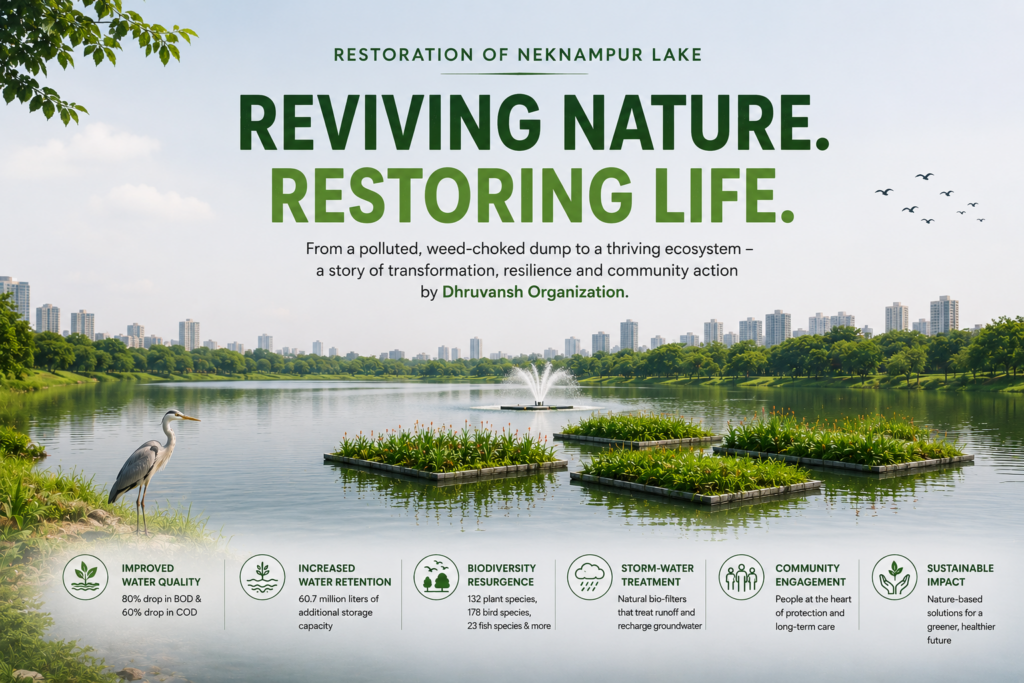
2. Restoration Methodology & Interventions
Dhruvansh’s approach prioritized phytoremediation (using plants to clean water) and bioremediation over expensive mechanical or concrete-heavy solutions. Key interventions included:
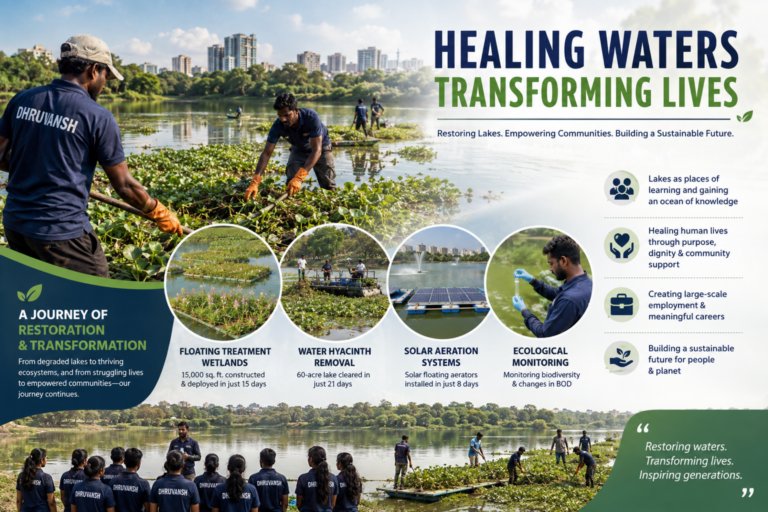
● Floating Treatment Wetlands (FTWs): The core of the project was the deployment of large floating islands (recognized as the largest in the country). A 6,000 sq. ft. raft was built using a base of recycled materials, gunny sacks, and gravel.
● Phytoremediation: Over 10,000 saplings of pollution-absorbing plants (e.g., vetiver, canna, bulrush, lemongrass, tulsi, ashwagandha, and mosquito-repelling citronella) were planted on the FTW. The roots form a dense biofilm that absorbs harmful nutrients (phosphates and nitrates) from the sewage.
● Weed Management: Instead of viewing water hyacinth purely as a nuisance, Dhruvansh cleared 80% of it and converted it into organic compost by mixing it with cow dung, using it to nourish the FTW plants and surrounding greenery.
● Aeration: Introduction of aerators to increase dissolved oxygen levels in the water.
3. Water Restoration & Storm-water Treatment
The restoration has led to a dramatic revival of the lake’s water quality and its ability to process urban runoff.
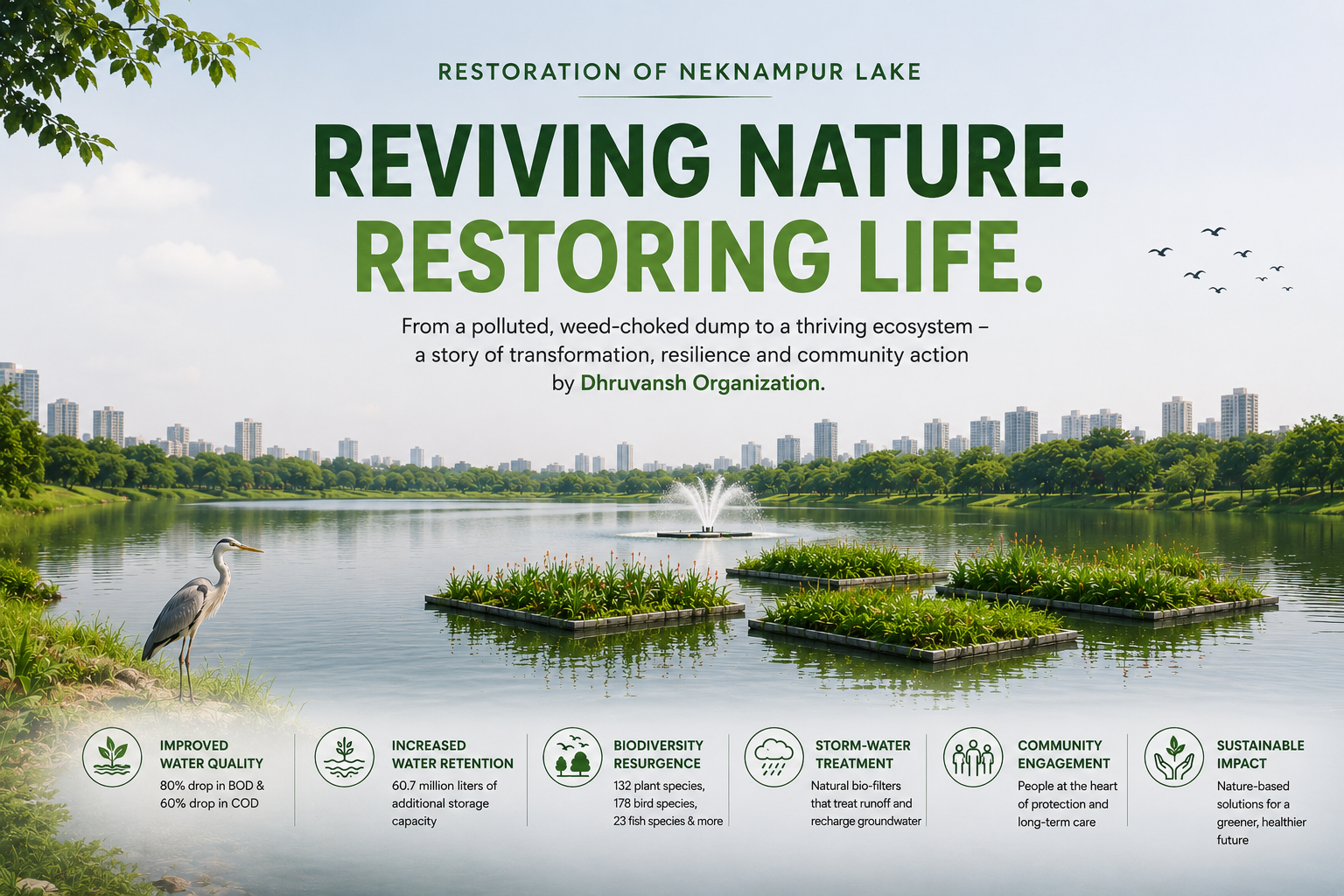
● Water Quality Improvements: The water transformed from a foul-smelling, murky state to being clear and visibly healthier. Data from the Telangana State Pollution Control Board showed a 80% drop in Biological Oxygen Demand (BOD) & 60% drop in COD at the lake’s outlet. The plants successfully absorbed excess nutrients, mitigating toxic conditions.
● Usable Freshwater: The lake now acts as the “kidneys of the landscape,” treating sewage and converting it into freshwater that can be safely used for gardening, fishing, and supporting local ecosystems.
● Storm-water Treatment: As urban areas generate heavy storm-water runoff carrying surface pollutants, the lake’s FTWs act as a massive bio-filter. The floating wetlands trap sediments and absorb chemical runoff, effectively treating urban storm-water before it can stagnate or contaminate deeper groundwater reserves.
4. Increased Water Retention Capacity
By clearing the lake bed and its surroundings, the project significantly improved the hydrological profile of the area.
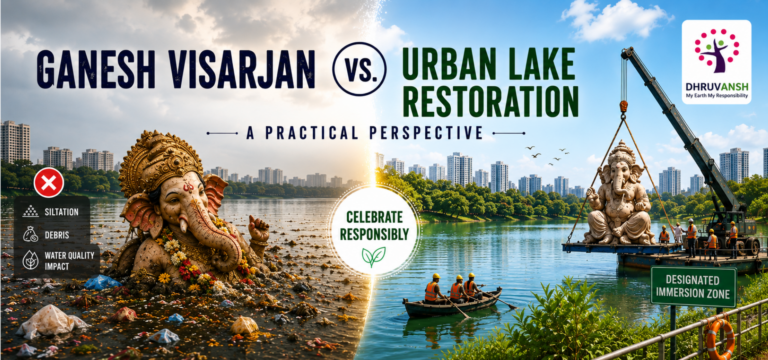
● Debris & Landfill Removal: The removal of legacy landfills, construction debris, and cultural siltation (aided by the creation of a separate Visarjan tank for idol immersion) drastically increased the physical volume of the lake basin.
● Catchment Area Expansion: By reclaiming and protecting the lake’s catchment area, the lake’s capacity to harvest and hold rainwater has surged.
● Groundwater Recharge: The desilted and cleared lake bed allows for much higher percolation rates, resulting in a significant increase in local groundwater recharge.
● Flood Mitigation: The increased water retention capacity acts as a vital buffer during heavy monsoons, substantially reducing the incidence of localized urban flooding in the surrounding neighborhoods.
● Hydrological Impact & Water Security : The most immediate and measurable effect of desilting is the restoration of the lake’s physical volume and its interaction with local groundwater.
• Massive Increase in Water Holding Capacity:
o Calculation: 15 acres is approximately 60,702 m2. If an average of 1m of silt is removed across the entire lake bed, the lake regains 60,702 m3 of volume. This equates to over 60.7 million liters of additional water storage capacity.
• Enhanced Groundwater Recharge: Over years of degradation, fine silt, clay, and organic sludge create an impermeable layer (a “hardpan”) at the bottom of the lake, preventing water from seeping into the ground. Removing this layer exposes the porous natural soil or bedrock beneath, drastically improving the percolation rate. This directly recharges local aquifers and raises the water table for surrounding communities.
• Urban Flood Mitigation: By reclaiming millions of liters of storage capacity, the 15-acre basin transforms back into an effective “sponge” during the monsoon season. It absorbs peak storm-water runoff, significantly reducing the risk of downstream flooding in nearby neighborhoods.
5. Biodiversity Resurgence
The lake has been re-established as a thriving biodiversity hotspot, transitioning from a dead zone to a vibrant ecosystem. Current recorded statistics include:
● Flora: 132 species of plants.
● Avifauna: 178 species of birds, including migratory and nesting species.
● Reptiles: 21 species, notably pythons, monitor lizards, and terrapins.
● Mammals & Insects: 12 species of mammals (including mongooses) and dozens of insect species.
● Aquatic Life: The restoration of aerobic conditions allowed for the re-initiating of fishing, supporting thousands of fish and reviving the aquatic food web.
6. Climate Impact & Carbon Footprint Reduction
Combining aquatic ecosystem restoration (a 15-acre lake) with massive terrestrial afforestation(1.5 Lakh saplings) creates a highly potent, dual-action climate mitigation engine. This model not only transforms the local hydrology and biodiversity but operates as a high-capacity carbon sink. The climate impact is achieved through three primary mechanisms: Direct Sequestration(trees and soil), Avoided Emissions (halting methane production from degraded water), and Indirect Energy Savings (urban cooling and groundwater recharge).
Here is a detailed analysis of the carbon footprint reduction impacts.
6.1. Direct Carbon Sequestration (The Plantation Factor)
Planting 1.5 Lakh saplings—likely utilizing dense afforestation techniques like the Miyawakimethod in the lake’s buffer zones and catchment area—provides the most measurable and dramatic reduction in atmospheric carbon dioxide ( ).
).
● Annual Carbon Drawdown (Mature State):
○ Calculation: While sequestration rates vary by species, age, and soil, a conservatively healthy native tree in a tropical/subtropical climate sequesters an average of  of
of  per year once it reaches maturity.
○ Total Impact:  of
of  .
.
○ This equates to  sequestered annually once the forest canopy matures.
● Biomass and Soil Carbon: Beyond the visible trunks and leaves, massive root networks pump carbon deep into the soil. Over a 20-year lifespan, this micro-forest will lock away tens of thousands of tons of carbon in terrestrial biomass and soil organic matter (SOM).
6.2. Avoided Greenhouse Gas Emissions (Lake Remediation)
Degraded, silt-filled lakes receiving organic waste (like sewage) are significant drivers of climate change at a micro-level. Restoring the 15-acre water body aggressively cuts these emissions.
● Halting Methane ( ) Production:
○ In a polluted, stagnant lake, organic matter decays without oxygen at the bottom (anaerobic decomposition). This process releases Methane ( ), a greenhouse gas approximately 25 to 28 times more potent than
  over a 100-year period.
○ Impact: By desilting the 15-acre lake bed, removing the rotting sludge, and introducing aeration (either natural via wind/depth or mechanical), the lake transitions to aerobicdecomposition. This fundamentally shuts down the methane factory, avoiding hundreds of tons of  -equivalent (
 ) emissions every year.
● Eliminating Nitrous Oxide ( ): Heavily polluted lakes also emit Nitrous Oxide, which is almost 300 times more potent than
  . Phytoremediation and nutrient filtering neutralize the nitrogen loads, stopping
  off-gassing.
6.3. “Teal Carbon” & Wetland Sequestration
While terrestrial forests store “Green Carbon,” healthy freshwater lakes and wetlands store what is increasingly referred to as “Teal Carbon.”
● Sediment Trapping: A healthy 15-acre lake with a restored ecosystem (including aquatic plants, phytoplankton, and benthic organisms) continuously draws down carbon from the water column and permanently buries it in the lake sediments.
● Wetland Flora: If the restoration includes floating treatment wetlands or shoreline reeds, these fast-growing aquatic plants rapidly absorb carbon. When they naturally die back and sink, they lock carbon into the anaerobic sediment layers, acting as a permanent geological sink.
6.4. Indirect Carbon Savings & Energy Efficiency
The ecological benefits of the project ripple outward, drastically reducing the carbon footprint of the surrounding human settlements.
● Groundwater Pumping Efficiency:
○ A desilted 15-acre lake acts as a massive percolation tank, vastly improving the local water table.
○ Impact: Surrounding residential and commercial complexes will not have to pump borewell water from depths of 1000+ feet. Pumping water from 200 feet requires exponentially less electricity than pumping from 1000 feet. Because grid electricity is often fossil-fuel dependent (coal), this reduction in pumping energy translates to a massive, hidden reduction in the community’s carbon footprint.
● Urban Heat Island (UHI) Mitigation & Cooling:
○ The combination of a 15-acre water body (evaporative cooling) and a 1.5 Lakh tree micro-forest (transpiration and shade) drastically alters the microclimate.
○ Impact: Ambient temperatures in the immediate vicinity can drop by  to
to  during peak summer. This directly reduces the reliance on Air Conditioning (AC) in nearby buildings, further curbing electrical consumption and associated greenhouse gas emissions.
7. Community Outreach & Social Impact
The project’s success is deeply rooted in its ability to engage the community, operating under the ethos of “My Earth, My Responsibility.”
● Extensive Campaigns: Dhruvansh has conducted over 400 environmental awareness campaigns addressing plastic, water, soil, air, and noise pollution.
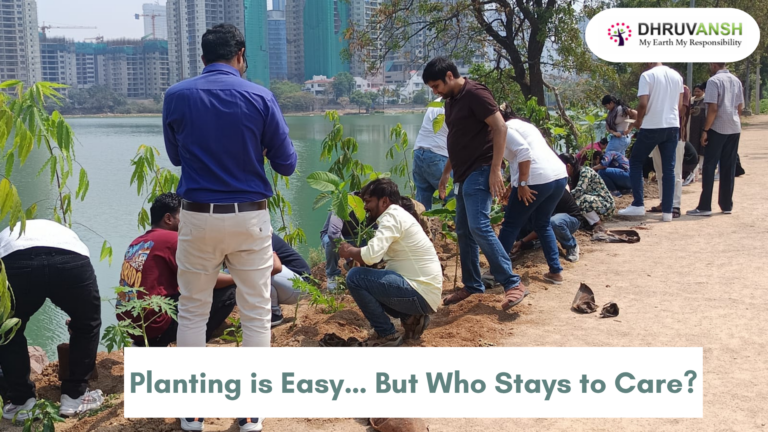
● Active Volunteerism: Every Saturday and Sunday, volunteer activities draw massive participation from school students, college researchers, senior citizens, and local residents, fostering a profound sense of social inclusion and ownership.
● Educational Hub: The site serves as a live research project for college students and a practical knowledge center for school children learning about urban ecology, global warming, and climate change.
● Livelihood Generation & Gender Equality: The restoration works—including planting, compost creation, and FTW maintenance—provided vital income opportunities for lower-income groups and women. Women work at the lake with equal zeal, promoting gender equality in environmental conservation.
● Sustainable Economy: To ensure long-term protection, the lake was made self-reliant. Activities such as re-initiating fishing, developing vegetable and papaya gardens, selling compost, and promoting eco-tourism generate revenue for the local community, ensuring their continued vested interest in the lake’s health.